Workshop on QCD Critical End Point and Effective Field Theory Methods (CEP-EFT 2026)

→ Asia/Shanghai
Description


Workshop on QCD Critical End Point and Effective Field Theory Methods 2026 


Overview:

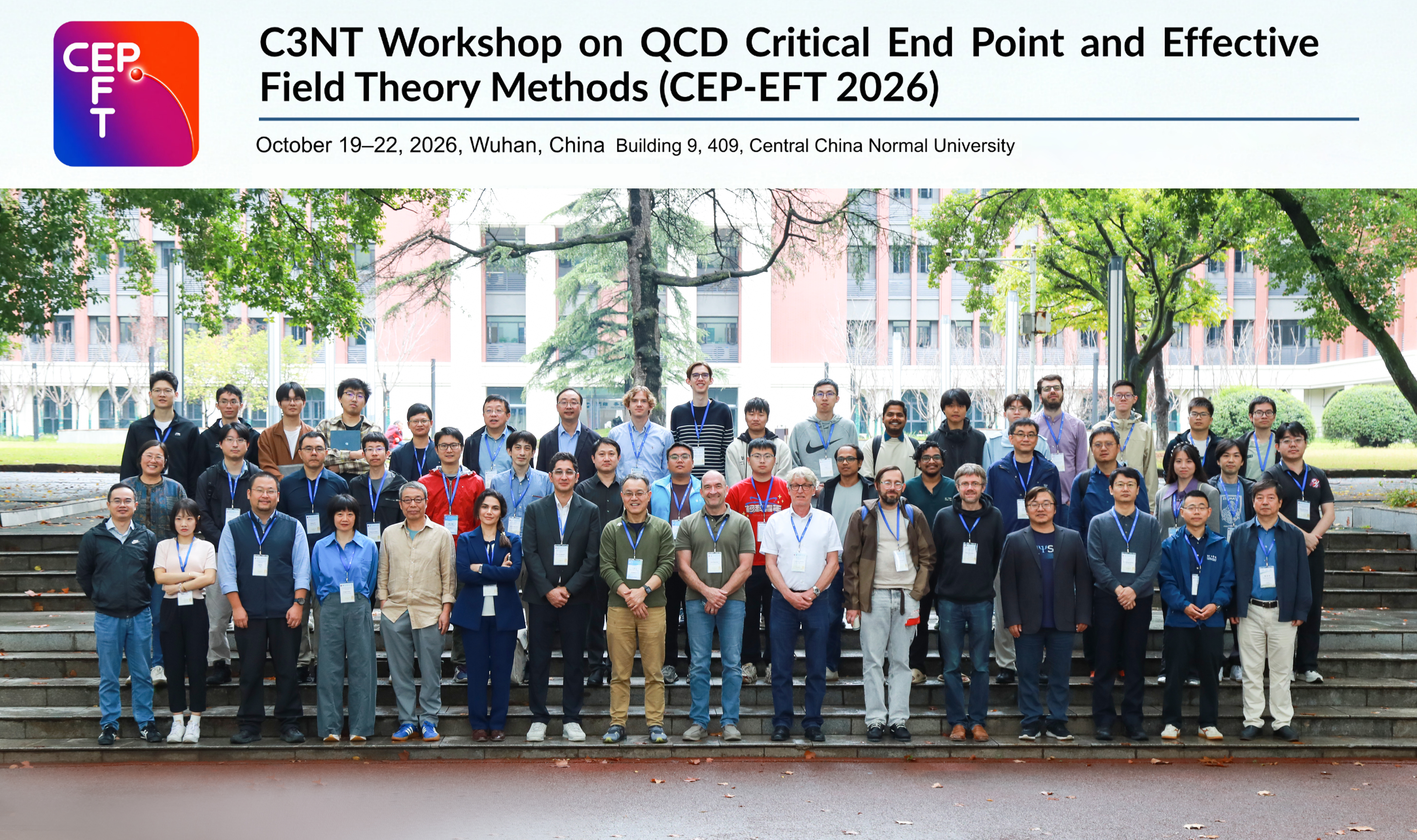
The Workshop on the QCD Critical End Point and Effective Field Theory Methods (CEP-EFT 2026) will be held at C3NT, Wuhan, China, on October 19–22, 2026. The workshop will bring together researchers working on critical phenomena, hydrodynamics, effective field theory, lattice QCD, and heavy-ion phenomenology to discuss recent progress on the QCD critical point and non-equilibrium dynamics.


Please note that presentation uploads are currently unavailable on our website. Please send your slides to Kaifan Ye (yekaifan@mails.ccnu.edu.cn) or to  Shi Pu (shipu@ustc.edu.cn).

Scientific Topics:

·       QCD Critical Point and Critical Fluctuations

·       Static and Dynamic Critical Phenomena

·       Hydro+ and Fluctuating Hydrodynamics

·       Stochastic and Schwinger–Keldysh Effective Field Theories

·       Transport, Correlations, and Fluctuation Observables

·       Lattice QCD Constraints on the QCD Phase Diagram

·       Heavy-Ion Phenomenology and BES-II

·       Strongly Coupled Dynamics and Holographic Approaches

·       Theory–Experiment Interface in Critical-Point Searches


Practical Information:

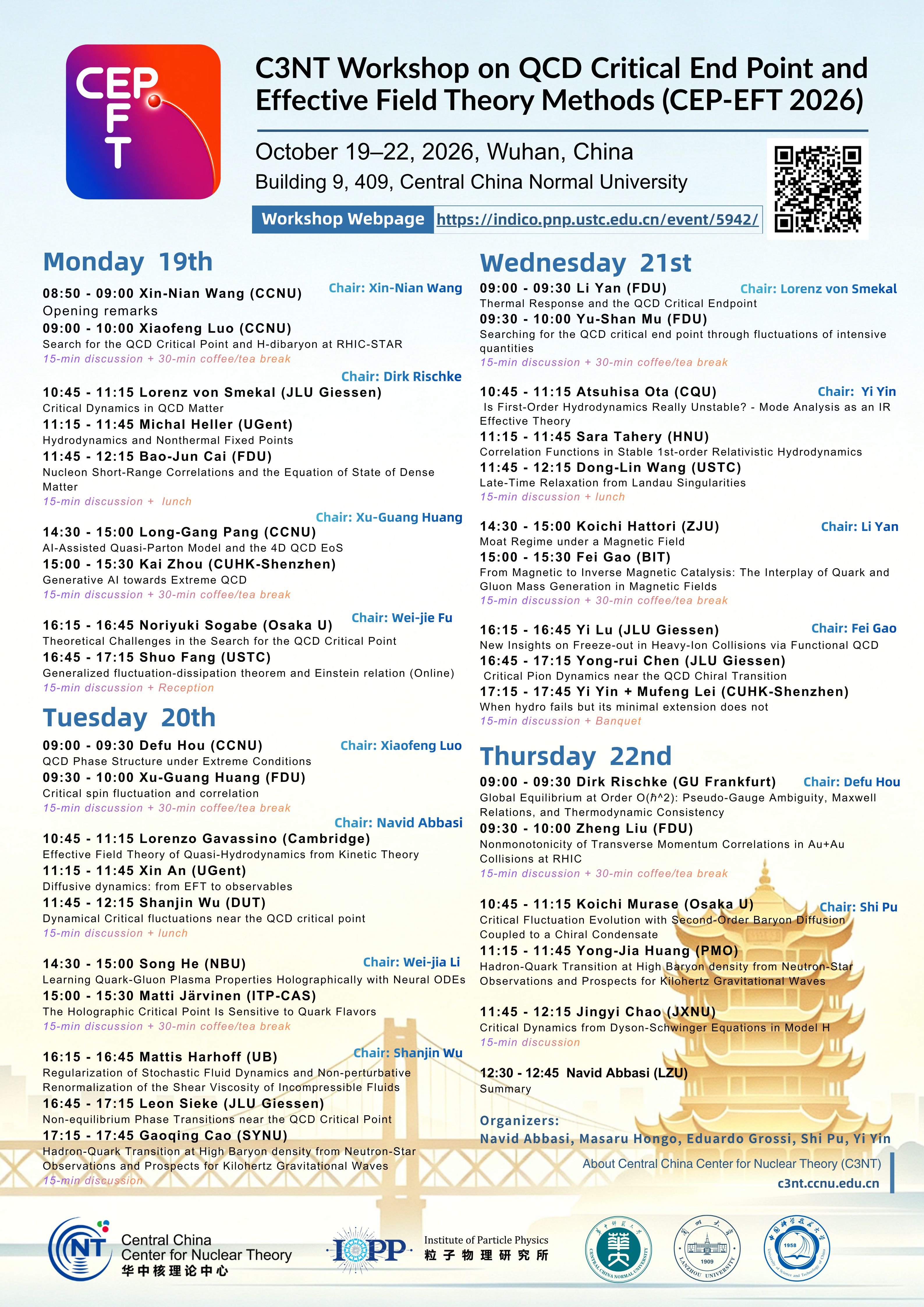
Registration: Room 409, Building 9, CCNU, 08:00 - 08:50, October 19, 2026.

Scientific sessions: October 19–22, 2026.

Registration fee: 600 RMB per participant.

Expected attendance: 40–60 participants.

Accommodation: Gui-Yuan Hotel at CCNU

Venue Location: Room 409, Building 9, CCNU
 

International Advisory Committee:

Blaise Goutéraux (CEA Saclay)

Sašo Grozdanov (University of Edinburgh)

Michał Heller (Ghent University)

Masakiyo Kitazawa (YITP, Kyoto Univeristy)

Dirk Rischke (Goethe University Frankfurt)

Thomas Schäfer (North Carolina State University)

Lorenz von Smekal (Justus Liebig University Giessen)


Organizer: 

Navid Abbasi (Lanzhou University)

Masaru Hongo (Niigata University)

Eduardo Grossi (University of Florence)

Shi Pu (University of Science and Technology of China)

Yi Yin (The Chinese University of Hong Kong, Shenzhen)


Sponsors: 

Central China Center for Nuclear Theory (C3NT)

Lanzhou University

University of Science and Technology of China


Registration
Registration Form
Participants
    • 10
      QCD Phase Structure under Extreme Conditions
      Speaker: Defu Hou
    • 11
      Critical spin fluctuation and correlation
      Speaker: Xu-Guang Huang
    • 10:00 AM
      Discussion
    • 10:15 AM
      Coffee break
    • 12
      Effective Field Theory of Quasi-Hydrodynamics from Kinetic Theory
      Speaker: Lorenzo Gavassino
    • 13
      Diffusive dynamics: from EFT to observables
      Speaker: Xin An
    • 14
      Dynamical Critical fluctuations near the QCD critical point
      Speaker: Shanjin Wu
    • 12:15 PM
      Discussion
    • 12:30 PM
      Lunch
    • 15
      Dilepton Emissions as a Probe of the QCD Critical Point
      Speaker: Gaoqing Cao
    • 16
      The Holographic Critical Point Is Sensitive to Quark Flavors
      Speaker: Matti Järvinen
    • 3:30 PM
      Discussion
    • 3:45 PM
      Coffee break
    • 17
      Regularization of Stochastic Fluid Dynamics and Non-perturbative Renormalization of the Shear Viscosity of Incompressible Fluids
      Speaker: Mattis Harhoff
    • 18
      Non-equilibrium Phase Transitions near the QCD Critical Point
      Speaker: Leon Sieke
    • 19
      Generalized fluctuation-dissipation theorem and Einstein relation (Online)
      Speaker: Shuo Fang
    • 5:45 PM
      Discussion
    • 20
      Thermal Response and the QCD Critical Endpoint
      Speaker: Li Yan
    • 21
      Searching for the QCD critical end point through fluctuations of intensive quantities
      Speaker: Yu-Shan Mu
    • 10:00 AM
      Discussion
    • 10:15 AM
      Coffee break
    • 22
      Is First-Order Hydrodynamics Really Unstable? - Mode Analysis as an IR Effective Theory
      Speaker: Atsuhisa Ota
    • 23
      Correlation Functions in Stable 1st-order Relativistic Hydrodynamics
      Speaker: Sara Tahery
    • 24
      Late-Time Relaxation from Landau Singularities
      Speaker: Dong-Lin Wang
    • 12:15 PM
      Discussion
    • 12:30 PM
      Lunch
    • 25
      Moat Regime under a Magnetic Field
      Speaker: Koichi Hattori
    • 26
      From Magnetic to Inverse Magnetic Catalysis: The Interplay of Quark and Gluon Mass Generation in Magnetic Fields
      Speaker: Fei Gao
    • 3:30 PM
      Discussion
    • 3:45 PM
      Coffee break
    • 27
      New Insights on Freeze-out in Heavy-Ion Collisions via Functional QCD
      Speaker: Yi Lv
    • 28
      Critical Pion Dynamics near the QCD Chiral Transition
      Speaker: Yong-rui Chen
    • 29
      When hydro. fails but its minimal extension does not
      Speaker: Yi Yin + Mufeng Lei
    • 5:45 PM
      Discussion
    • 6:00 PM
      Banquet
    • 30
      Global Equilibrium at Order O(hbar^2): Pseudo-Gauge Ambiguity, Maxwell Relations, and Thermodynamic Consistency
      Speaker: Dirk Rischke
    • 31
      Nonmonotonicity of Transverse Momentum Correlations in Au+Au Collisions at RHIC
      Speaker: Zheng Liu
    • 10:00 AM
      Discussion
    • 10:15 AM
      Coffee break
    • 32
      Critical Fluctuation Evolution with Second-Order Baryon Diffusion Coupled to a Chiral Condensate
      Speaker: Koichi Murase
    • 33
      Hadron-Quark Transition at High Baryon density from Neutron-Star Observations and Prospects for Kilohertz Gravitational Waves
      Speaker: Yong-Jia Huang
    • 34
      From the Keldysh Ansatz to Statistical Evolution
      Speaker: Jingyi Chao
    • 12:15 PM
      Discussion
    • 35