1. Yellow Mountain (黄山)
Yellow Mountain, a famous tourist spot with the title of world cultural and natural heritage. Yellow Mountain is located in southern Anhui Province, around 300 km from Hefei city. It is famous for the "five wonders" of strange pines, strange rocks, sea of clouds, hot springs, winter snow and historical relics.
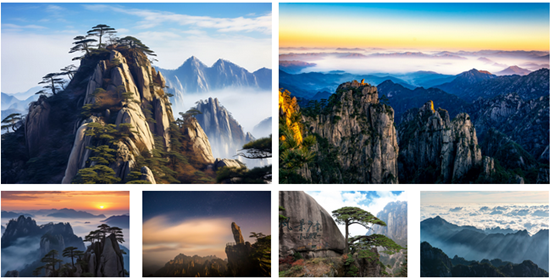
Mount Huangshan is crowned as a World Cultural and Natural Heritage, Global Geopark, and World Biosphere Reserve internationally, and a National Scenic Area, National Civilized Scenic Area, and National 5A Tourist Attraction domestically. It is recognized as an outstanding icon of China's magnificent landscapes and splendid culture, together with the Yangtze River, the Great Wall, and the Yellow River. Enjoying the reputation of "A Wonderland on Earth" and "The No. 1 Mountain of Wonder in the World", Mount Huangshan is famous for its "Five Wonders", that is, strangely-shaped pines, fantastic rocks, sea of clouds, hot springs and winter snow. It boasts a great many beautiful peaks and strange rocks, of which 88 peaks are over 1,000 meters above sea level, especially the three main peaks, i.e. the Lotus Peak, the Bright Summit Peak and the Tiandu Peak, which are all over 1,800 meters above sea level. Xu Xiake (1587-1641), a great traveler of the Ming Dynasty, visited Mount Huangshan twice and acclaimed: "Mount Huangshan tops all the other mountains." The quote was revised by later generations to a new version, which goes: "The landscape of the Five Great Mountains belittles those elsewhere, and the landscape of Huangshan tops that of the Five Great Mountains".
Located in Huangshan City in southern Anhui Province, Mount Huangshan is about 40 kilometers long from north to south and 30 kilometers wide from east to west, covering a total area of about 1,200 square kilometers, of which 160.6 square kilometers are developed as Mount Huangshan Scenic Area. Mount Huangshan was originally named Yishan Mountain for its dark green peaks and rocks, which appeared even grayer in the distance. Legend has it that this is the place where the Yellow Emperor collected herbs for refining elixirs, and finally became an immortal. The mountain was renamed Mount Huangshan in the sixth year of the Tianbao reign (AD 747) by Emperor Xuanzong of the Tang Dynasty for his belief in Taoism. Over the past thousand years, Mount Huangshan has accumulated a rich culture themed on the Yellow Emperor, with many of its attractions named after his legend, including Xuanyuan Peak, Liandan Peak, Rongcheng Peak, Fuqiu Peak, Danjing Well, Xiyao Stream, and Shaiyao Terrace.
Mount Huangshan is the quintessence of 800-million-year geological development, integrating peak forest landforms and glacial relics, and featuring rich typical geological landscapes, such as shaped granite stones, granite caves, springs, ponds, streams and waterfalls. In addition, it boasts a stable and balanced ecosystem, with complete and vertically distributed plant communities, and especially an alpine swamp and an alpine meadow, thus winning the reputation of the "Treasure House of Plants in East China" and the "Natural Botanical Garden". The scenic area is covered by forest for up to 98.29%, reaching a greening rate of 98.53%. With crisscrossed ravines and dense vegetation, Mount Huangshan is an ideal place for wild animals to dwell and breed, so there are rich species of wild animals.
Thanks to the dense forests and numerous streams and waterfalls, Mount Huangshan Scenic Area retains Class I in terms of its air quality all year round, with the concentration of negative oxygen ions in the air permanently at above 20,000/cm3, thus known as the "Natural Oxygen Bar".
Specialty Food: Mount Huangshan Clay oven rolls, Smelly mandarin fish, Huizhou Mao Tofu
Location: Huangshan District, Huangshan City
Transport: Accessible by direct public Transport from Huangshan Bus Station and High-speed Railway Station.
2. The Ancient City of Huizhou
 |
 |
The Ancient City of Huizhou is a scenic area located in the downtown of Xixian County, a National Historical and Cultural County. It is one of the four well-preserved ancient cities in China, the seat of the ancient Huizhou government, and an important part of the Ancient Anhui Cultural Tourism Area, a national 5A tourist area. The ancient city presents fascinating landscapes contributed by five beautiful peaks and six zigzag rivers. The scenic area is home to elegantly-arranged ancient residential complexes, with plain ancient bridges, towers, streets, alleys, dams and archways, just like a historical museum of great magnificence. This is the birthplace of "Anhui Culture", one of China's three major regional cultures, and is known as the "Sea of Cultural Relics", "State of Culture", "Capital of Anhui Ink", "Hometown of Xixian Inkstones" and "Southeast Cultural City". The attractions here include: The Barbican Entrance, Nanqiao Tower, Huizhou Government Office, Anhui Huizhou History Museum, Ancient City Wall, Xu Guo's Stone Stele, Huiyuan Garden, Cao's Residences·- Hui Combo Memorial Hall, Tao Xingzhi Memorial Hall, Doushan Street, Yuliang Scenic Area, boating tours and so on.
Specialty Food: Mount Huangshan Clay oven rolls,Smelly mandarin fish, Huizhou Mao Tofu
Location: Huicheng Town, Xixian County, Huangshan City
Transport:Take Route 6001 at Tunguang Zhuanpan bus stop to transfer at Fengle Xiyuan to Xixian Route 2 to reach Huizhou Fuya, and the ancient city is within a walking distance.
3. Hefei
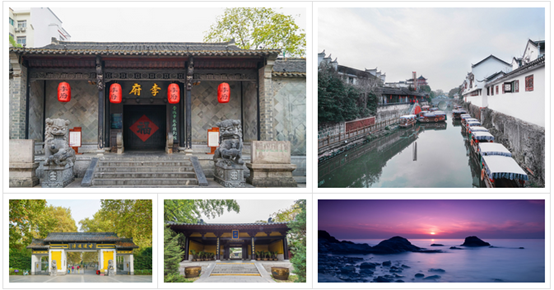
Hefei is a city located in the middle of Anhui Province between the Yangtze and Huaihe Rivers, is a place where you can visit historical sites such as Li Hongzhang's former residence and the Three Rivers Ancient Town to experience the charm of traditional culture; visit natural landscape areas such as Chaohu Lake Scenic Spot and Luogang Central Park to enjoy the bounty of nature; and browse through Hefei's pedestrian streets, shopping malls, and other modern cityscape areas to experience the city's bustle and vitality.The detailed introductions are followed:
Li Hongzhang's former residence: Li Hongzhang is the important minister of late Qing Dynasty. Li Hongzhang's residence, built in the Guangxu period, belongs to the typical late Qing Dynasty Jianghuai residential architecture, featuring neat layout, carved beams and painted buildings. The attraction consists of two parts: “Li's House” and “Huai System Pavilion”. Li's Mansion is mainly visited in the ancient architecture of the Jianghuai pattern and Li Hongzhang calligraphy plaques. The exhibition hall of the Huai system shows the influence of the Huai system on modern military, economy and culture.
Xiaoyaojing Park:Located in Shouchun Road, Luyang District, Hefei City, Anhui Province, the park is not only a place of beautiful natural scenery, but also carries a rich history and culture. The park is an antique pavilion, the use of multi-storey, heavy eaves of the building structure, dark bronze corridor columns and gray and black antique doors and windows, the second floor windows with beams outside the corridor surrounded by the top floor under the eaves of the horizontal plaques written on the “trace of the Wu Wei,” the first floor of the entrance to the vertical plaques written on the “Pavilion”. “The park is also home to the Plum Blossom Hill. In addition, there are also famous scenic spots in the park such as Plum Blossom Hill, Peony Garden, Azalea Garden, Hidden Ghost Garden, Bonsai Garden and Duxiu Peak.
Lord Bao Park:Situated southeast of the old city of Hefei, this park was established to commemorate Bao Zheng (999-1062), a famous minister of the Northern Song Dynasty (960-1127).It has an open-air layout and mainly comprises the Temple of Lord Bao, Tomb of Lord Bao Qingfeng Pavilion and Fuzhuang Yard.Under the theme of "Historical Lord Bao, Cultural Lord Bao and Antiques of Lord Bao", the park represents Lord Bao's life of "loyalty, filial piety and rectitude" from different angles and in different forms.
Chaohu Lake: Chao Lake also known as Chao Hu, situated in Hefei, the capital of Anhui Province. It is the largest in Anhui and one of the five largest freshwater lakes in China, which stretches three counties in Hefei in the middle of Anhui Province. Mushan Island is in the lake.The silver fish, shrimps, and crabs of Lake Chao are called the Three Treasures. It enjoys the grand name of “Land of Plenty”.
Sanhe Ancient Town: Sanhe Ancient Town, located in Feixi County, Hefei City, Anhui Province, by the side of Chaohu Lake, boasts a history of over 2,500 years. Named after the three rivers that run through it – Fengle River, Hangbu River, and Xiaonan River – Sanhe Ancient Town is known for its water town charm. It features a rich array of cultural landscapes and has formed the unique “Eight Ancients” scenery of the Jianghuai region, which includes former residence of Chen Ning Yang (Nobel Laureate in Physics), ancient rivers, bridges, weirs, streets, dwellings, tea houses, temple stages, and battlefields.
Recommended Travel Routes:
1. Lord Bao Park— Xiaoyaojin park —Li Hongzhang's Former Residence
2. Sanhe Ancient Town
Specialty Food: Sanhe Rice Dumplings, Sanhe Stir Fry, Crispy Duck Noodles with Small Knives, Crispy Duck Noodles in Round Sauce, Sanhe Shrimp Paste, Sanhe Dried Tea, Sanhe Rice Wine, Stinky Mandarin Fish, Li Hongzhang Chowder, Wushan Goose, Zhanji Peach Crisp,Sanhe Rice Wine